
Group therapy

Why Is Group Therapy So Effective?
Sometimes change happens when we do more than talk about our challenges. In our group therapy programs, participants will have the opportunity to learn practical skills, practise them in a supportive environment, and build the confidence to use them in everyday life. Our aim is for you to leave with more than just insight - with useful tools, practical experience, and greater confidence in navigating challenges.
How can group therapy help?
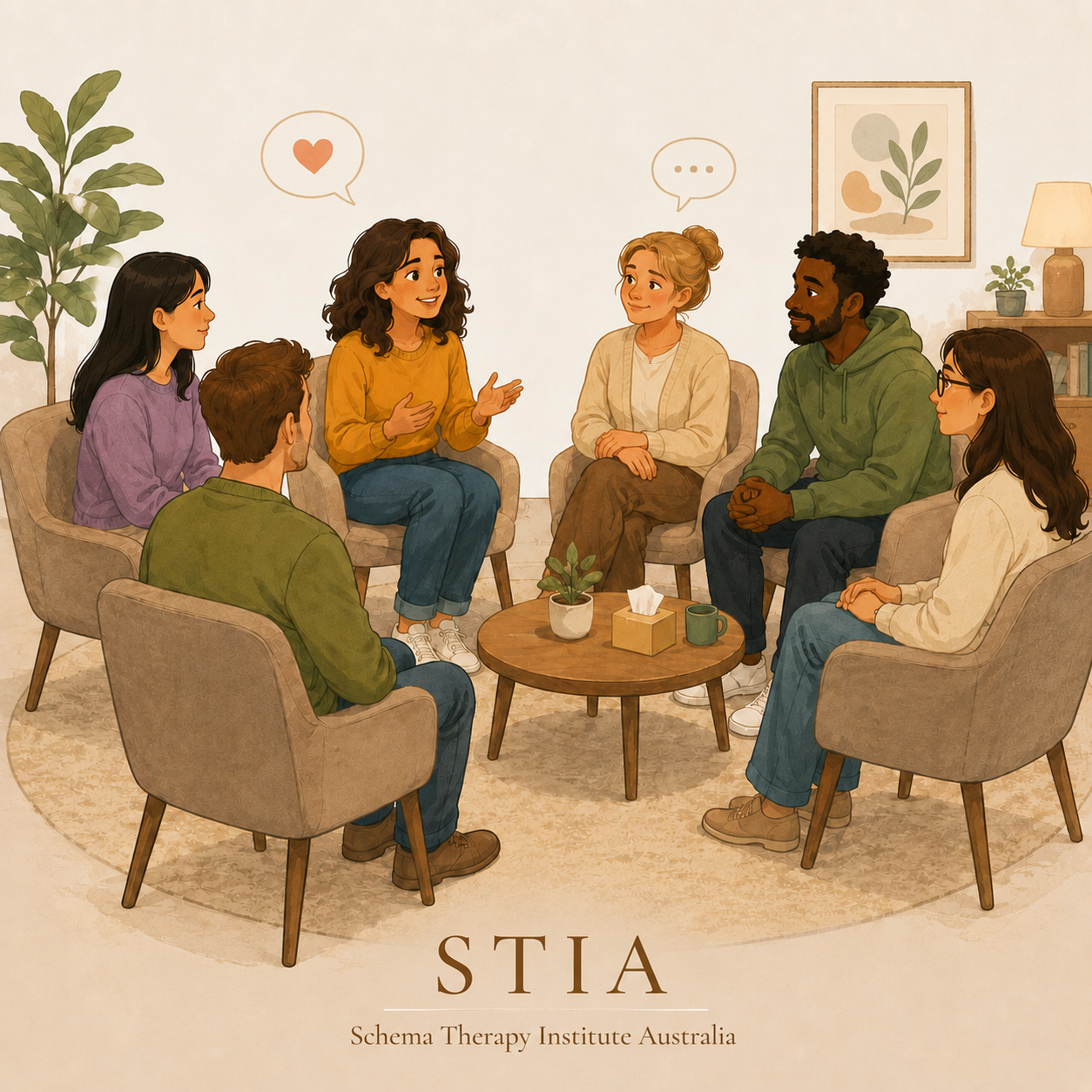
Group therapy offers a unique therapeutic experience that addresses areas in a way that individual therapy may not be able to. While individual therapy provides valuable space for personal reflection and exploration, groups create opportunities to connect with others who may be navigating similar challenges.
Many people who participate in group therapy describe experiencing a sense of belonging, validation, and normalisation as they realise they are not alone. The group setting provides a safe space to practise communicating needs, expressing emotions, setting boundaries, and building trust with others.
Groups also allow participants to learn from different perspectives, receive support, and develop new ways of relating to themselves and others.
Groups Offered at STIA
-
What is Schema Therapy?
Schema Therapy is a treatment modality that goes beyond simply symptom management, exploring how individuals can improve their overall quality of life, develop stronger and healthier relationships, and find a sense of autonomy and competence in their lives. It is typically a longer-term therapy modality that focuses treating psychological challenges through, cognitive, behaviour, and emotional corrective experiences. To date Schema Therapy has strong evidence with complex psychological problems that have had little response to other forms of treatment.
What is Group Schema Therapy?
The Group Schema Therapy program at STIA, is an adaptation of a group program that was developed by Professor Joan Farrell & Ms Ida Shaw. The group treatment program integrates psychoeducation on the development of Schemas & Modes and how they relate to psychological problems and symptoms, emotional awareness training, distress management/coping skills and improved relationships.
What does the program actually entail?
The group treatment program integrates psychoeducation on the development of Schemas & Modes and how they relate to psychological problems and symptoms, emotional awareness training, distress management/coping skills and improved relationships. The current group program involves 20 group sessions that are delivered weekly, with each session lasting 90 minutes.
Is there a Pre-requisite?
Our Group DBT Skills Training is recommended for individuals who are considering completing Group Schema Therapy at STIA. Developing effective coping strategies and adaptive skills can provide a helpful foundation for engaging in the Schema Therapy program. Feedback from previous Group Schema Therapy participants has highlighted the value of building these skills prior to commencing the group program. While participating in the program, it is also recommended that you continue to engage with your individual therapist to support your group work.
What will be asked of me?
You will be required to complete an assessment package that will be sent to you upon acceptance to the group to ensure the program is a right fit for your individual needs. Participants are expected to attend all sessions across the 20 weeks. Participants are also expected to complete all in between session tasks that are set week to week.
How do I register?
Please navigate to the ‘available groups’ section above and select the group you are interested. It is here that you will also find information about pricing and start dates. -
What is DBT and DBT skills?
Dialectical Behavioural Therapy (DBT) is a long-term intensive treatment designed on the basis of dialectical and biosocial theory of psychological disorders. It was originally developed as a treatment for individuals diagnosed with Borderline Personality Disorder, or chronic suicidality. The view of DBT is that emotions are brief, involuntary, and patterned responses to an individuals internal and external world. Our DBT skills group differs from standard DBT as the aim of our DBT Skills group is to utilise the skills component of DBT to assist individuals to create changes emotionally, cognitively, behaviourally and interpersonally. The skills are designed to aid in impulse control, emotion regulation, self-image, and strengthen interpersonal relationships.Why do DBT Skills Training?
Group therapy has proven to be an effective treatment for a number of psychological problems and disorders. DBT Skills Training differs to many other group therapies as it is not a process-oriented group that focuses on processing one’s feelings. Rather, group DBT Skills Training is designed to provide individuals an opportunity to learn new, more adaptive skills and ways of coping by using skills that have been taught. Think of it as a skills lab, where you are provided with techniques and tools to practice adaptive coping in your everyday life. Although DBT was originally created as a treatment for Borderline Personality Disorder, the research on DBT has grown significantly, with evidence indicating that DBT can be useful for a vast range of mental health disorders including anxiety and depression, as well as difficulties with impulse control.What does the program actually entail?
The DBT Skills Training group at STIA is an adaption of DBT Skills Training that was developed by Marsha Linehan. The DBT Skills Training group runs for 12 weeks, integrating skills from the 4 key modules (Mindfulness, Interpersonal effectiveness, Emotion Regulation, and Distress Tolerance). The aim of the 12 weeks is to focus on key skills/techniques for each module to assist group members to develop emotional awareness, as well as more adaptive coping skills. Our Group DBT Skills Training is also recommended for individuals who are considering completing Group Schema Therapy at STIA. The current DBT Skills Training group involves 12 group sessions that are delivered weekly, with each session lasting 90 minutes.What will be asked of me?
There is no initial assessment for the program, however it is expected that participants complete a an acceptance package that includes a life history questionnaire and an attachment questionnaire.
How do I register?
Please navigate to the ‘available groups’ section above and select the group you are interested. It is here that you will also find information about pricing and start dates. -
What is the ADHD strategies group?
The adult ADHD strategies group is a program that is neuro-affirming and aims to support ADHDers in understanding their brain, identifying their strengths, and developing practical strategies that work with their individual needs.
The program is based on a neuro-affirming approach that recognises ADHD as a different way of processing information, regulating attention, and engaging with the world. Rather than focusing on changing who you are, the program aims to support you in developing tools and strategies to navigate everyday life with greater self-understanding and confidence.
The program explores practical strategies across areas such as attention, memory, organisation, time management, impulsivity, problem solving, relationships, sleep, and emotional wellbeing. It also acknowledges the experiences that many ADHDers may encounter, including overwhelm, frustration, self-criticism, anxiety, or low mood, and provides support for building sustainable ways of coping.
Why do Adult ADHD strategies Training?
Group programs can be a valuable way to learn new skills, connect with others, and explore different ways of navigating everyday challenges. Our Adult ADHD Skills Group differs from traditional process-oriented groups, as it is not focused on exploring or processing emotions within the group setting. Instead, the program provides a structured and supportive environment where ADHDers can learn practical strategies, experiment with different approaches, and develop tools that align with their individual needs.
Think of it as a skills lab — a space to build understanding of your ADHD brain, practise strategies, and explore what works best for you in daily life. The program draws on evidence-based approaches, including Cognitive Behaviour Therapy (CBT) and behavioural principles, while incorporating a neuro-affirming perspective that recognises different ways of thinking, learning, and engaging with the world.
What does the program actually entail?
The Adult ADHD Skills Group runs for 13 weeks and explores practical strategies across areas such as attention, memory, time management, organisation, problem solving, and relationships. The program also includes discussion of experiences that are commonly experienced by ADHDers, such as mood changes, anxiety, emotional regulation difficulties, anger, and patterns of coping that may no longer feel helpful.
The current Adult ADHD Skills Group is a 13-week program consisting of one 90-minute group session each week. It is recommended that participants be engaged in their own individual therapy.
What will be asked of me?
You will be required to complete an assessment package that will be sent to you upon acceptance to the group to ensure the program is a right fit for your individual needs. Participants are expected to attend all sessions. Participants are also expected to do all in between session tasks that are set week to week.
When does it start?
The ADHD program is run 2- 3 times a year. Please contact the group coordinator at group@stia.com.au for more information.
How do I register?
Please navigate to the ‘available groups’ section above and select the group you are interested. It is here that you will also find information about pricing and start dates.
Is Group Therapy For Me?
Group therapy may be a good fit if you are looking for additional support, want to feel more connected with others, or are interested in learning and reflecting alongside people with similar experiences. Some people join group therapy to complement their individual therapy, while others are looking for a structured and supportive space to build coping skills, improve relationships, or better understand themselves. You do not need to feel “ready” or confident in groups to benefit. It is very common to feel nervous or uncertain before starting.
A pre-group assessment can help determine whether the group is the right fit for your needs and goals. Group therapy can also be a helpful option if you have already used your individual Medicare sessions for the calendar year, as eligible group therapy sessions can be accessed separately under Medicare with a valid Mental Health Treatment Plan and referral from your GP or psychiatrist.